Moving To and From Your Storage Unit
You already have the storage unit. What you need now is a crew to move your belongings there or back out again without damaging anything in the process. We work with storage facilities across the Bay Area and coordinate access hours and gate codes directly so you do not have to manage that back and forth.
Licensed & Insured
Cal-T201700
You Have the Storage Unit. We Handle the Move.
You already figured out the storage. You have a unit at Public Storage in Concord, Extra Space in Oakland, CubeSmart in Richmond, iStorage in Berkeley, or wherever makes sense for your situation. What you need now is a crew to get your belongings there, or back out again, without damaging anything in the process.
That's what this service is. We show up at your storage facility or your home, load everything correctly, and deliver it where it needs to go. We work with any storage facility in the Bay Area and coordinate access hours, gate codes, freight elevator reservations, and facility check-in requirements directly. You don't manage the logistics between the crew and the facility. We do.
Every job includes a trained crew, a fully equipped truck, moving blankets, shrink wrap, tape, floor runners, and crew tools at no extra charge, plus up to 2 TV boxes and 5 wardrobe boxes for use during the job. Furniture gets wrapped before it goes into the unit and placed in the correct rooms when it comes back out. We disassemble pieces that won't fit through doors and reassemble at the destination. Billing is hourly with a minimum, 15-minute increments after that, and every estimate includes a written Not to Exceed price. California double drive time applies between pickup and delivery as required by state regulation.
Licensed under Cal-T201700 with full cargo and liability insurance.
How It Works
-
Get your free estimate. Call (510) 495-1884 or fill out our online form. Tell us the direction of the move (into storage, out of storage, or split-destination), the facility name and address, your unit size, and what's in the load. We give you an honest quote with a Not to Exceed price.
-
We coordinate with the facility. Gate codes, access hours, elevator reservations, and any facility-specific rules get handled before the crew arrives. You pass us the information, we handle the logistics.
-
We show up and handle it. The crew arrives on time, wraps furniture on site, and loads or unloads the unit. For split-destination moves, we load strategically so each stop unloads cleanly.
-
Everything lands where it belongs. Storage-bound items go into your unit with heavy pieces against the walls, boxes stacked tight, fragile items on top, and soft items filling gaps so nothing shifts. Home-bound items get placed in the correct rooms with furniture reassembled.
Loading a Storage Unit the Right Way (It's Not Like Loading a Truck)
Most people load a storage unit the same way they'd load a moving truck. This is the wrong approach, and it's the reason so much stored furniture comes out damaged months or years later.
A moving truck is loaded for a short trip with active packing materials in between items. Things go in, the truck drives a few miles to a few hundred, and everything comes out within hours or days. A storage unit is loaded for weeks, months, or years of static storage. The physics are completely different. Stacks settle under their own weight over time. Temperature and humidity cycle through the unit even in climate-controlled facilities. Road vibration isn't a factor but gravity is, continuously, for the entire storage duration.
Here's what a properly loaded storage unit looks like.
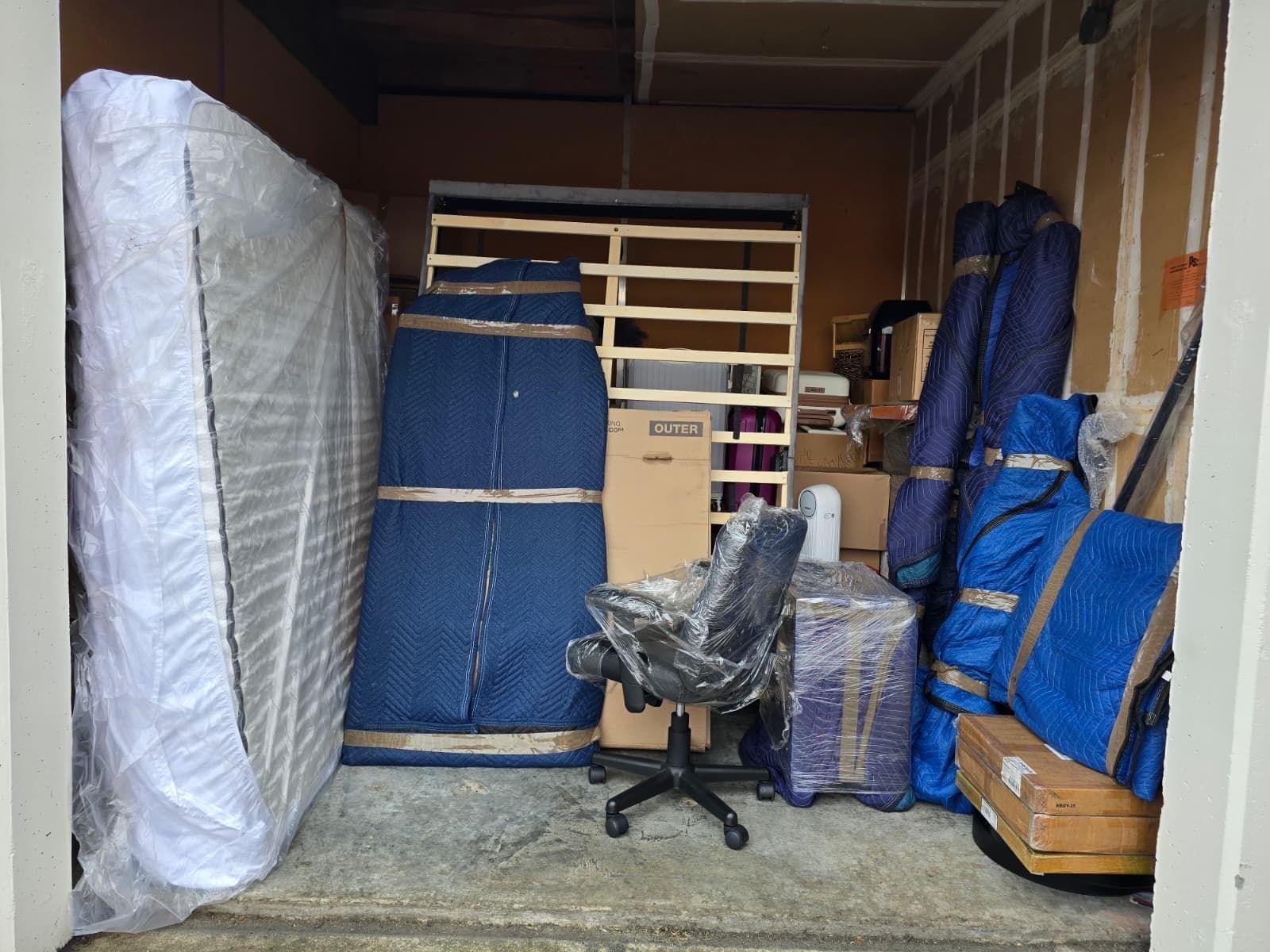
Heavy furniture against the walls, standing upright. Dressers, bookshelves, wardrobes, and heavy case goods go against the unit walls first. They provide structural stability for everything else and don't get crushed by items stacked on top.
Mattresses on their edges, not flat. A mattress laid flat on the floor of a storage unit gets compressed by the weight of anything stacked on it, and over months of storage the compression becomes permanent. Mattresses stood on their edges against a wall keep their shape and provide a protective barrier between furniture and the unit walls.
Boxes stacked in columns, floor to ceiling, heaviest on the bottom. Same principle as a truck load, but more important for long-term storage because the weight pressure is continuous rather than temporary. A box stacked under 200 pounds of boxes above it for six months will be crushed even if the box itself is sturdy.
Fragile items and high-value pieces at the top or in a protected corner. Artwork, mirrors, electronics, and anything breakable goes where nothing stacks on top of it. Ideally in a corner with other items forming a natural wall of protection.
Leave an aisle if the unit will be accessed. If you're going to pull things out periodically (holiday decorations, seasonal gear, business inventory), build the load with a center aisle so you can reach the back without dismantling the whole unit. This is a use-case-specific decision: for pure long-term storage, max out the space; for active-access storage, give up some capacity for usability.
Wrap everything, especially soft goods. Upholstered furniture, mattresses, and anything with fabric should be wrapped in plastic furniture covers or shrink wrap before going in. Dust accumulates on exposed fabric during long storage, and rodents or insects can find their way into even well-maintained climate-controlled facilities. Wrapped furniture comes out of storage looking the way it went in. Unwrapped furniture often doesn't.
Don't put damp or moist items in. Appliances that weren't properly drained, plants, anything wet. Moisture in a sealed storage unit turns into mildew, mold, and damage to everything around it.
We handle all of this as part of the load. The crew wraps every piece on site before it goes into the unit, plans the stack to prevent long-term crushing, and places items strategically based on whether the unit will be accessed or sit untouched.
Pulling Everything Out of a Unit That's Been Sitting
Unloading a storage unit after months or years of storage is different from unloading a truck that just drove across town. Things shift. Stacks settle. Items that were carefully placed may be in different positions by the time you're pulling them out.
A few realities worth knowing before the crew arrives.
Pulling out takes as long as loading in, sometimes longer. People expect the retrieval to be faster than the original load because "we're just taking things out." In practice, pulling out a settled unit often takes the same time or longer, because the stack has to be disassembled carefully without triggering cascades of falling boxes.
Long-stored items may have picked up damage. Dust is universal. Mildew happens in non-climate-controlled units and sometimes in climate-controlled ones during Bay Area rainy seasons. Rodent damage is rare in modern facilities but not impossible. Boxes that absorbed moisture from a leak or humidity can be structurally compromised and tear when lifted. The crew will flag any visible issues as items come out of the unit, which matters because the time to document storage damage is before things leave the facility, not after they've been delivered to a new home.
Wrapping may be compromised. Shrink wrap degrades under UV exposure and temperature swings. Plastic covers get brittle. Cardboard boxes absorb moisture and weaken. Items that were properly wrapped two years ago may need to be re-wrapped before transport, which the crew handles on site.
Inventory check while the crew pulls items. If you have a list of what went into the unit, walk through it as items come out. It's common for something small to be forgotten in the back of a unit after a long storage period. Better to catch it at the facility than to realize three days later that something didn't make it out.
Split-Destination Moves: Home and Storage in One Trip
Split-destination moves are one of the most common reasons people call this service, and they're underused because most customers don't realize it's an option.
The pattern: part of your load goes to your new home, the rest goes to a storage unit, all in one trip. One truck, one crew, two stops, one invoice.
When this makes sense.
Downsizing with a timeline. Moving from a 3-bedroom home to a 1-bedroom apartment. Not everything fits, and you're not ready to decide what to sell or donate yet. Storage holds the surplus while you figure it out.
Temporary smaller place. Moving into an interim rental while waiting for a new home to close, finish construction, or become available. Most of your household goes to storage, daily-use items go to the rental.
Home staging for sale. The house is about to go on market and needs to be depersonalized. Personal items, extra furniture, and anything that won't help sell the home goes to storage. The staging-friendly pieces stay.
Renovation relocations. You're renovating part of the home and need to clear a room or multiple rooms for construction. The displaced furniture goes to storage for the duration of the project.
College kids and lease turnover. A student whose summer lease gap means the apartment contents need to store from May to August, but they're moving the laptop and a few suitcases to their summer situation.
How the logistics work.
The crew loads the truck so items destined for each stop come off cleanly without reshuffling. This is a deliberate loading pattern, not random order. Items going to the first stop get loaded last, because they come off first. Items going to the second stop get loaded first, against the back wall, because they come off last. The crew does this automatically when you tell us which stop is first.
Typical sequencing: home first, storage second, when the home needs to be set up for immediate living and the storage can wait. Or storage first, home second, when the storage is closer to the origin and the home is further away. We route the trip to minimize drive time based on your actual addresses.
Cost math.
A split-destination move is almost always cheaper than two separate jobs. A separate storage pickup and a separate home delivery means two crew mobilizations, two trucks, two minimums, and (on a second-day job) two deposits. A split-destination move is one of everything, with drive time between stops billed normally at California double drive time from the first stop to the second.
What to Know Before the Crew Arrives
Appliances need to be ready. Refrigerators, freezers, washers, and dryers must be fully disconnected, drained, and dried at least 24 hours before the crew arrives. Moisture inside an appliance that sits in storage becomes mildew and damages everything around it. Our crew moves the unit but does not disconnect or reconnect plumbing, gas, or electrical lines, which is specialist work.
Let your facility know movers are coming. Confirm that access is available during your scheduled window. Pass along any gate codes, access card numbers, freight elevator reservations, or facility check-in procedures to the crew lead. Some facilities require the tenant to be on site for unit access. Others allow authorized movers to access alone if arranged in advance. Check your facility's policy.
Facility-specific constraints matter. Is the unit on the ground floor or upper floor? Are there elevators, and do they need reservations? Is the facility climate-controlled with specific access rules (some require hand carts only, not dollies with pneumatic tires)? Are there weight limits on floors above ground level? Are moves restricted to certain hours? Most of these are simple questions the facility manager can answer in five minutes, and the answers change how the crew plans the job.
Clear a path if you can. Not required, but it saves time on the clock. If your unit is packed tight or the hallway to the unit is cluttered with other tenants' spillover, clearing a path ahead of time speeds up the crew significantly.
Tell us about stairs or elevators at both locations. The original estimate call should include this. Stairs and elevator waits affect how long the job takes, and surprises on move day push the final bill past the initial range.
Storage Facility Quirks by Type
Not all storage facilities operate the same way, and the operational differences affect how a move runs.
Climate-controlled indoor facilities. Public Storage, Extra Space, CubeSmart, and most national brands have multi-story indoor facilities with climate control. These units are usually accessed by elevator, often with specific cart rules (the facility provides flatbed carts and prohibits pneumatic-wheel dollies on the floors to protect the flooring). Freight elevators may require reservations on busy days. Move hours are often restricted to facility business hours, which can be tighter than 24-hour outdoor facilities.
Drive-up outdoor facilities. Traditional storage with direct vehicle access to each unit. Fastest for loading and unloading because the truck parks directly at the unit door. Less common for new construction but still widespread. Often 24-hour access with a gate code.
Hybrid facilities. Some outdoor units, some indoor. The unit you have determines how the crew approaches it.
Portable container storage yards. PODS, 1-800-PACK-RAT, and similar container companies often store their containers at company yards. If your storage is actually a container at a yard rather than a traditional self-storage unit, see our portable container loading service, which is the specific service for that situation.
Commercial and warehouse storage. Larger-volume storage in warehouse spaces, sometimes used by businesses or customers with very large loads. Access and logistics vary widely and are facility-specific.
If you're not sure what type your facility is or how it affects the move, mention the facility name when you call and we'll handle it.
Storage Moves We Do Every Week
Renters between leases. Someone whose lease ends before their new place is ready. Contents go to a storage unit, live somewhere temporarily, then come out when the new place is available. Often a 1-to-3-month gap. Common pattern in Oakland, Berkeley, Alameda, and Albany during summer lease turnovers.
Downsizing with storage bridge. Moving from a larger home to a smaller one, with the pieces that don't fit going to storage while the family decides what to keep, sell, or pass to other family members. Common in Walnut Creek, Orinda, and the hills around Oakland and Piedmont, especially for seniors and families navigating life transitions.
Staging for sale. A home going on market needs to be depersonalized and decluttered. Personal items, extra furniture, and non-staging pieces go to storage for the listing period. After the sale, contents either come out and go to the new home or transition to a different storage situation.
Renovation relocations. Kitchen remodel, full gut renovation, or construction requiring clearing of multiple rooms. Contents store for the duration and come back when work is complete. These jobs often have flexible timelines that depend on the construction schedule.
College and graduate student summer storage. UC Berkeley, UCSF, and other Bay Area universities generate a cycle of May pickups into storage and August retrievals to new housing. See our college moving service for the student-specific version of this pattern.
Business and office storage. A business relocating, consolidating, or temporarily reducing space that needs furniture, files, and equipment stored. Different operational profile from residential but same core service.
Long-term family storage. Customers who've had a storage unit for years and are finally consolidating, moving, or clearing it. These jobs often involve items that haven't been touched in a long time and need careful pulling-out with damage assessment as things come out.
What to Do Now
- Call or fill out the online form for a free estimate. Tell us the direction of the move (in, out, or split), the facility, the load size, and your access details.
- Contact your facility and confirm access hours, gate codes, elevator reservations, and any authorized-movers policies.
- Handle appliance disconnects at least 24 hours before the move, with the appropriate vendor.
- Make a rough inventory list if you're pulling out a unit that's been sitting, so you can confirm everything makes it out.
- Decide what's going to each destination if the job is split between home and storage.
- Clear access paths on both ends if possible, though the crew handles the heavy lifting regardless.
Before hiring any mover for storage work, verify their California moving license through the BHGS license search tool. Moving belongings to or from a storage unit still requires a licensed mover under California law. Our license number is Cal-T201700.
If you need someone to coordinate the full gap between your move-out and move-in dates, including finding and managing the storage, see our moving and storage coordination service. For loading and unloading portable containers like PODS, see our storage container loading service.
See all our moving services or get your free estimate today.
Get a Free Estimate
Call us or fill out our form for an honest quote with no hidden fees.
(510) 495-1884Or fill out our formWhy JH Moving
Moving and Storage Services in Action
Everything You Get With Home-to-Storage & Storage-to-Home Moving
What Customers Say About Our Storage Moves
Real customers, real moves, real results.
Frequently Asked Questions
Yes. Our crew meets you at your storage facility, pulls everything out of the unit, loads the truck, and delivers to your home or the next destination. Furniture gets wrapped in blankets and shrink wrap before it leaves the unit, and placed in the correct rooms at the delivery end. We work with any storage facility in the Bay Area (Public Storage, Extra Space, CubeSmart, Stor-All, iStorage, and the rest) and coordinate access hours and gate codes directly so you don't have to manage the back and forth.
You Might Also Need
Ready to Move Into or Out of Storage?
Get a free estimate today. Tell us the facility, the load, and the direction of the move. We handle the rest.
Licensed Cal-T201700. 300+ five-star reviews. Family-owned and based in Richmond for 7 years.
Call (510) 495-1884 or request your free estimate online.
Serving the East Bay & Bay Area