Full-Service Packing in Richmond, CA
JH Moving provides full-service packing in Richmond and across the Bay Area. Our trained packers handle every room in your home, from the kitchen cabinets to the bedroom closets, so you never touch a roll of tape. We bring the supplies your quote covers, pack on a schedule that fits your move, and unpack at your new place. Call (510) 495-1884 for a free packing estimate.
Licensed & Insured
Cal-T201700
What You Get With Full-Service Packing
Most people don't realize how long packing takes until they're standing in the kitchen at midnight surrounded by crumpled newspaper and half-wrapped plates. It's the part of moving nobody wants to do, and the part that causes the most damage when it's done wrong.
JH Moving's full-service packing takes the entire job off your hands. After we walk through your home (or review detailed photos you send), we arrive with the crew size that fits and every supply the job needs. That includes double-walled dish boxes for the kitchen, unprinted packing paper for fragile items, bubble wrap, corner protectors for artwork, and any additional cartons your pack requires. Every booked move also includes tape, shrink wrap, moving blankets, floor runners, corner guards, up to 2 TV boxes, and up to 5 wardrobe boxes at no extra charge.
We pack every room, label every box by destination room and contents, and stack everything for the moving crew. We also unpack at your new place as quoted. Boxes go to the right rooms, fragile items come out of their wrappings, used paper and empty boxes leave with the crew.
Licensed under Cal-T201700 with full cargo and liability insurance. Packing supplies are quoted as line items so you see exactly what the materials cost.
How Full-Service Packing Works
-
Get your free estimate. Call (510) 495-1884 or fill out our online form. We walk your home (or review detailed photos) and give you a written quote for crew time and materials. California law requires moving estimates to be based on an in-person or video walkthrough. Phone-only quotes aren't enforceable.
-
We pack your entire home. Our crew arrives on packing day with what we quoted. We work room by room, wrapping dishes, boxing closets, protecting furniture, and securing electronics. Every box gets labeled by room and contents so unpacking matches the layout at the new home.
-
We load and move the next day (or the same day for smaller packs). For anything larger than a 1-bedroom, we almost always recommend packing on a separate day so the moving crew can load efficiently the next morning without packing pressure.
-
We unpack and clean up. At your new home, we unpack boxes, place items where you want them, and remove all used packing materials. You're settled in from day one.
The Real Time Math: Room by Room
Most customers dramatically underestimate packing time, and it's not their fault. Unless you've packed professionally, you have no real benchmark for how long each room actually takes. Here's the reality with a 2-person crew:
The kitchen is almost always the longest single room, running 3 to 5 hours. Dishes, glassware, pantry items, small appliances, cookware, utensils, spice racks, the contents of every drawer. Every breakable item needs individual wrapping. Glasses get paper stuffed inside before the outer wrap. Plates get wrapped and packed vertically in dish boxes, not stacked flat. Pantry items get weight-balanced in their boxes so they don't shift. A kitchen with a lot of wine glasses, china, or specialty cookware easily pushes 5 hours. A sparse kitchen of daily dishes and a few pots is closer to 3.
Garages and storage areas: 4 to 8 hours. The wildcard room on almost every move. Years of accumulated tools, holiday decorations, sports equipment, yard supplies, and miscellaneous items that never got a permanent home. Garages are cluttered in ways the rest of the house isn't, and packing them requires sorting while packing, which slows everything down. Tell us about the garage honestly at the walkthrough. This is where estimates go wrong when customers say "it's not much" and we arrive to a two-car garage packed to the rafters.
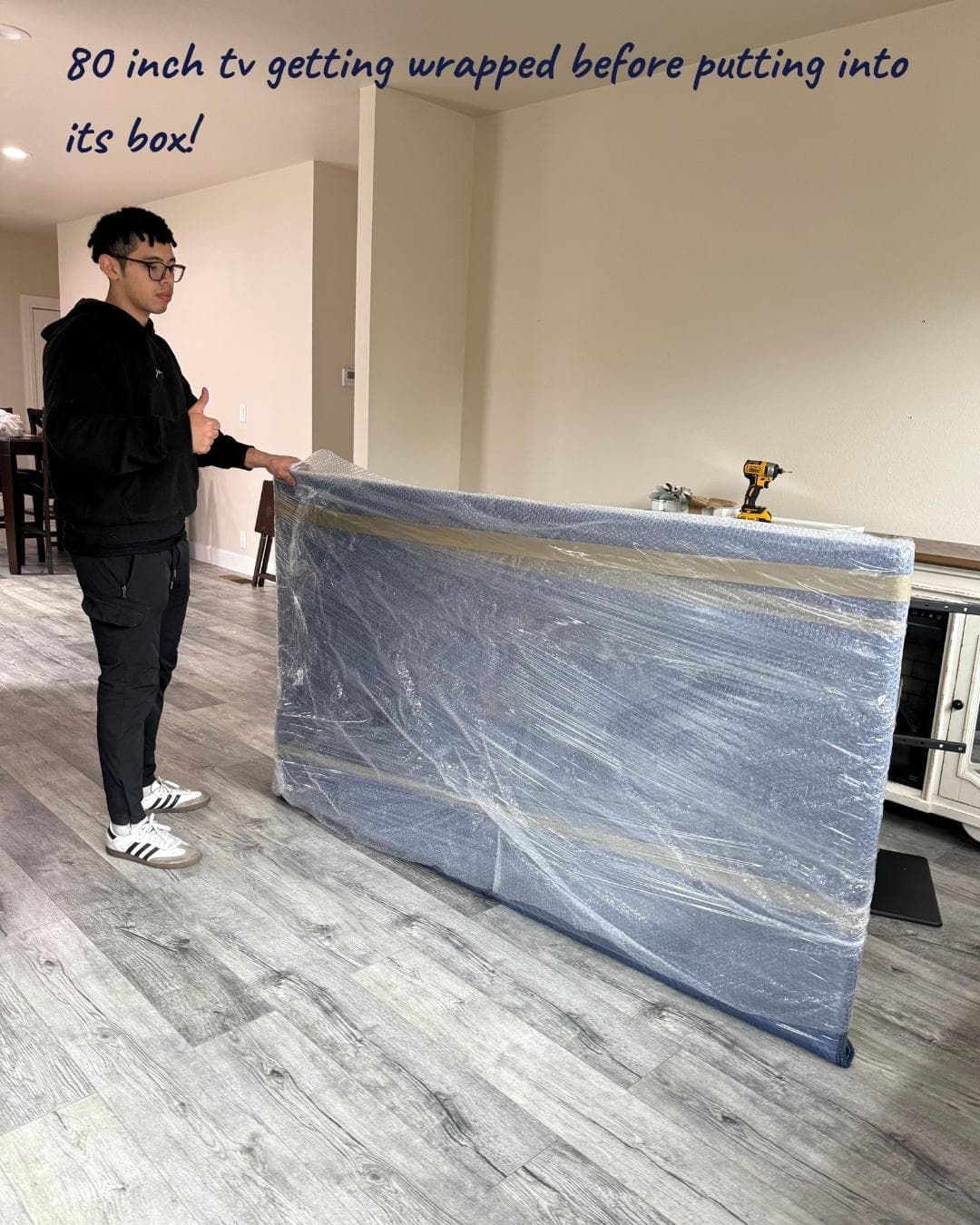
Living room: 2 to 4 hours. Furniture protection, electronics, art, media equipment, books, decor. TVs go in TV boxes with anti-static wrap. Artwork gets glassine, bubble wrap, and corner protectors. Books go in small boxes (book boxes are small specifically because books get heavy fast). Electronics ideally go in their original packaging if you still have it. If not, they get wrapped and padded with appropriate materials.
Bedrooms: 1.5 to 3 hours each. Clothes on hangers go directly into wardrobe boxes (included, up to 5 per move). Folded clothes go into boxes by category. Dresser drawers get unloaded. Never moved full, because weight stresses the joinery and can damage the furniture. Bedding gets its own boxes. Nightstands, lamps, and bedside items get wrapped and boxed. A primary bedroom with a walk-in closet runs longer than a smaller bedroom.
Bathrooms: 45 minutes to 90 minutes each. Faster than most rooms because items are smaller and there's less furniture. Medications go in a labeled bag you keep with you, not on the truck. Toiletries get boxed. Towels and linens get their own box or double up as padding in other boxes.
Home office: 2 to 4 hours. Books, files, electronics, desk contents, office supplies. Filing cabinets should be emptied into boxes (labeled by folder or section) and never moved full. Computers and monitors get anti-static wrap and appropriate boxes. Cables and small electronics go in labeled bags.
Add it up. A 3-bedroom home with a kitchen, living room, home office, primary bedroom, two secondary bedrooms, two bathrooms, and a garage runs roughly 18 to 26 hours of total packing work. With a 3-person crew, that's 6 to 9 hours of elapsed time on packing day. With 2 people, 9 to 13 hours, which is why we size up the crew for larger packs.
This is why the same 3-bedroom home that takes our crew 8 hours on packing day takes a typical DIY packer 4 to 5 full days spread across evenings and weekends.
What a Professional Pack Actually Looks Like
"We pack your stuff" is vague. Here's what it actually means technique by technique, room by room, and why it matters for whether your belongings arrive intact.
Kitchen technique.
Dishes get wrapped individually in unprinted newsprint (newspaper ink transfers to ceramic and leaves stains that are hard to remove). Plates stack in bundles of 3 to 5, wrapped together with cushioning between each plate, and go into dish boxes on their sides vertically, never flat. Flat-stacked plates crack from the weight of items above them. Vertical plates distribute load across their strongest axis. Dish boxes are double-walled corrugated cardboard specifically designed to resist crushing. Regular cartons don't have the structural strength and collapse under weight.
Glasses get paper stuffed inside the glass first, then wrapped individually from the base up. Stemware and wine glasses go into cell divider boxes that hold each glass in its own chamber, isolated from neighbors. Crystal and high-value glassware get double-wrapped with bubble wrap over the paper.
Pots, pans, and cookware get nested where possible with padding between, but heavy cast iron goes in its own smaller boxes. Heavy items in large boxes become dangerous to carry and can break through the bottom.
Pantry items get layered by weight: heaviest on the bottom (canned goods), lightest on top (boxed pasta, cereal). Liquid containers get sealed in plastic bags before boxing in case of leaks. Glass bottles (olive oil, vinegar, wine, liquor) get individual wrapping and padding. A broken wine bottle in a box full of paper goods ruins everything else in the box.
Artwork and mirrors.
Glassine paper (archival, acid-free) goes against the surface first so nothing the wrapping touches can interact with the finish. Then bubble wrap. Then cardboard corner protectors on all four corners. Then a custom-sized mirror carton, not a general-purpose box. Artwork travels upright, never flat, and nothing gets stacked on top of it. Labeled "FRAGILE - ART" on multiple sides.
Electronics.
Original packaging is ideal. If you still have the box your TV, monitor, or audio gear came in, that's better than anything a mover brings. Manufacturers design packaging specifically for shipping and include foam inserts fitted to the device. If original packaging is gone, electronics get anti-static wrap (regular bubble wrap can generate static that damages sensitive components), foam corner protection, and appropriately sized cartons with packing paper filling every void.
Clothes and closets.
Clothes on hangers go directly into wardrobe boxes. No taking them off and folding, no stacking them flat. Wardrobe boxes have a bar across the top that the hangers hook onto, so everything stays on the hanger through the move. Folded clothes go into boxes by category. Shoes get boxed separately (they're heavy and dirty, which you don't want mixing with clothes).
Books.
Books go in small boxes, never large. A large box full of books is dangerously heavy and can break through the bottom. Small boxes force you to limit the weight per carton, which is exactly what you want.
Furniture.
Case goods (dressers, armoires, bookcases, sideboards) get their drawers removed and wrapped separately. Moving a full dresser stresses the joinery and can damage both the drawer slides and the case. The body gets blanket-wrapped and shrink-wrapped with corner protectors on every edge. Beds get disassembled with all hardware in labeled bags taped to a piece of the bed so it doesn't go missing.
This is what "packing" actually means on a professional pack, and it's why pro packs take a fraction of the time of DIY packs while producing dramatically better outcomes.
The Pack-the-Day-Before Decision
For any home larger than a 1-bedroom, the single most important scheduling decision is whether to pack on the same day as the move or the day before. It has real consequences for both cost and outcome quality.
Same-day pack-and-move. The crew arrives in the morning, packs through midday, loads in the afternoon, and you're in the new place by evening. Works for studios and smaller 1-bedrooms where the total packing work is 2 to 4 hours and the move itself is 3 to 5 hours. The day is long (10 to 14 hours end to end) but everything happens in one window.
Packing day before, move day next. Day one, the crew arrives in the morning and packs through afternoon. Nothing moves yet. The home is boxed up, labeled, and ready. Day two, the crew comes back and the day is all loading, driving, unloading, and placement. Each day runs 5 to 8 hours instead of one 12-hour marathon.
For 2-bedrooms and up, two-day almost always wins. Here's why. A crew rushing to finish packing so they can start loading has less time to wrap each item carefully. Rushed packing is where breakage happens. When packing is its own day, every carton gets the attention it deserves. The crew is also fresher on load day because they didn't spend the morning wrapping glassware on their knees.
From your side, the two-day option is easier to schedule around the rest of your life. You sleep in your bed the night before move day instead of on a bare mattress surrounded by boxes. You can do a final walkthrough of the house in the morning. You're not frantically watching the clock at 7 PM wondering if the kitchen will be done before dark.
Two-day packing isn't more expensive in total hours. It's usually slightly less, because nothing is rushed and the work is more efficient. Your estimate will reflect the structure that fits your home.
Supplies: Why We Quote Materials Separately
Most full-service packers roll supplies into a flat packing fee. We don't. We quote materials as line items in your estimate. Here's the honest reasoning.
A flat-fee pack charges everyone the same regardless of what their home actually needs. A customer with a sparse kitchen and minimal fragile items subsidizes the customer with a china collection, a wine cellar, and a wall of framed art. The flat-fee customer doesn't see where their money goes, which is convenient for the mover but not for the customer.
When we quote materials separately, you see exactly what the job needs. A typical 2-bedroom pack with a moderate kitchen and some fragile items might use:
- 2 to 3 dish boxes for the kitchen
- 6 to 10 small/medium boxes for miscellaneous rooms
- 3 to 5 mirror cartons for artwork and framed items
- 1 to 2 rolls of bubble wrap
- 1 bundle of unprinted packing paper
- Wardrobe boxes (up to 5 included with the move) and TV boxes (up to 2 included)
- Tape, stretch wrap, markers
Materials for that job typically run a few hundred dollars. Materials for a 4-bedroom home with extensive art, china, and a full kitchen might run several times that. Quoting separately means you pay for what your home actually needs, not a smoothed average across everyone else's homes.
Every booked move also includes items we never charge for: moving blankets, shrink wrap, tape, floor runners, corner guards, door jamb protectors, crew tools, up to 2 TV boxes, and up to 5 wardrobe boxes. These are part of the move itself, included in the hourly rate, whether you book packing or not.
When Partial Packing Makes Sense
Full-service isn't always the right call. Some customers want to pack most of their own home and only hire us for the parts that are genuinely hard to pack well.
Partial packing works when:
- You have the time and patience to pack bedrooms, closets, and bathrooms yourself (these are the easiest rooms to DIY)
- You know the kitchen, the china cabinet, or the art collection is beyond what you want to tackle
- You want to control costs on the packing side but not at the expense of damage risk on the high-value items
Common partial-packing scopes:
- Kitchen only (usually 3 to 5 hours with a 2-person crew)
- Fragile items across the whole house: china, glass, artwork, mirrors
- Home office and electronics
- Garage
If you want the structure of professional packing just on your breakables, our fragile item packing service is built for exactly that. Same materials, same techniques, scoped only to the items that actually need the skill.
When to Book Packing Services
Packing slots fill up the same way moving slots do. For a planned move, book packing 3 to 4 weeks ahead, and longer if you're in peak season (May through September, end of month, summer weekends). If we're handling both packing and the move, we coordinate the schedule so packing day and move day are sequential. Usually pack Friday, move Saturday, or pack Saturday, move Sunday.
For time-pressured moves (a sudden lease change, a cancelled packer, a close date moved up) call us and we'll tell you what's available. Same-day packing is doable for studios and small 1-bedrooms when crews are available. For larger homes, even rush packing typically needs at least a day or two of lead time.
Packing Work We Do Every Week
Pre-sale packing for real estate moves. Sellers preparing to list who need to depersonalize and declutter before staging. We pack personal items, art, and anything not staying for staging. Common in Walnut Creek, Orinda, and the hills around Oakland and Piedmont.
Full-service move packs. The main pattern: homeowners or renters who've booked our moving service and added packing. Usually pack the day before, move the day after.
Downsizing and senior moves. Parents moving from family homes into smaller residences or retirement communities like Rossmoor. Careful packing of lifetime belongings, usually coordinated with family members or a senior move manager. See our senior moving service for more.
High-value and fragile-only packs. Customers who pack most of their home themselves but hand off the kitchen, the art, or the china. Our fragile item packing handles these specifically.
Last-minute packs. Someone whose original packer cancelled, or who realized packing was further behind than they thought a few days before move day. We accommodate when we can.
Office and commercial packs. Different operational profile: files, equipment, workstation contents. See our office packing service for more.
What to Do Now
- Call or fill out the online form for a free estimate. Walkthrough is the difference between a loose estimate and a tight one.
- Decide between full-service, partial, or fragile-only based on what you want to hand off.
- Decide between same-day or two-day packing. For anything larger than a 1-bedroom, we usually recommend two-day.
- Separate anything not moving before packing day so we don't box it up by accident.
- Point out high-value or fragile pieces during the walkthrough so we bring the right materials.
- Keep essentials with you. Medications, documents, chargers, clothes for a few days. These go with you, not in a box.
Before hiring any packer, verify their California moving license through the BHGS license search tool. Our license number is Cal-T201700.
Pair your packing with our full-service residential moving for a complete door-to-door experience. Or if you only need help with breakables and valuables, our fragile item packing covers that. Browse all options on the packing services hub.
Get a Free Estimate
Call us or fill out our form for an honest quote with no hidden fees.
(510) 495-1884Or fill out our formWhy JH Moving
Professional Packing Services & Moving Supplies in Action
Everything You Get With Full-Service Packing & Unpacking
What Customers Say About Our Packing Services
Real customers, real moves, real results.
Frequently Asked Questions
Packing is billed hourly with a minimum, and pricing is explained upfront before work starts. Crew size, home size, clutter level, access, and stairs all affect the total. A typical 1-bedroom pack runs 3 to 5 hours with a 2-person crew. A 2-bedroom runs 5 to 8 hours with a 2 to 3 person crew. A 3-bedroom runs 7 to 12 hours, and for anything this size we almost always recommend packing on a separate day from the move itself. Packing supplies (dish boxes, packing paper, bubble wrap, and additional cartons beyond the included TV and wardrobe boxes) are quoted separately as part of the packing service, so you see exactly what the materials cost before the crew arrives. A $100 deposit secures your date and applies to the final invoice. Call (510) 495-1884 for a free estimate.
You Might Also Need
Ready to Let Us Handle the Packing?
Get a free estimate for full-service packing. Supplies and labor are spelled out before we start. No per-box surcharges, no mystery fees.
Licensed Cal-T201700. 300+ five-star reviews. Family-owned and based in Richmond for 7 years.
Call (510) 495-1884 or request your free estimate online.
Serving the East Bay & Bay Area